If there's one thing business has learned since the economic meltdown of 2008, it's this: In a tough market, the key to success is innovation. Businesses who do nothing but imitate competitors not only don't get ahead, but start falling further and further behind.
And guess what? Having a diverse workforce is no exception. For many companies, diversity recruiting programs have taken a back seat in the past couple of years. That's a mistake, and here's why:
1. Diversity innovators have a huge opportunity right now
In a sluggish employment market, companies that take the initiative in diversity recruiting have a better chance of standing out from the competition. Not only can they attract the best and brightest of a diverse talent pool, but they can reap other benefits, like an improved employment brand and better media opportunities.
In other words, a little bit of effort can go a long way in the current market.
2. The market may be slow, but it hasn't stopped
The talent pool may be a little less competitive than it was 3 or 4 years ago, but there are still all kinds of roles and industries which are suffering from chronic talent shortages. Diverse talent pools are still the best 'untapped' source of talent for many of these hard-to-fill roles. Ignoring diversity recruiting strategies now will increase your time-to-hire, cost-per-hire and quality of hire in the next 12 months.
3. You're letting your competitors gain the advantage
When your competitors are tapping into the full talent pool - including diverse candidates - they're giving themselves the best opportunity to get the A-list candidates before you do.
What's more, your competitors are setting themselves up for long-term success: When the market improves (and it always does), they'll already be well-established in the diversity talent market, while you're still playing catch-up.
Don't think of diversity recruiting as a 'mandate' that you have to adhere to. Think of it as an opportunity to get ahead of the competition - and set yourself up for success in the long term.
Wednesday, December 14, 2011

Monday, December 5, 2011
Your Recruitment Brand is Undermining Your Consumer Brand
Your sales and marketing department is working overtime to reach a diverse target market: They're creating advertising in different languages, making sure a wide variety of cultures and lifestyles are reflected in your marketing initiatives, and doing their best to make sure your consumer brand is appealing to a diverse community.
So how come your recruitment efforts aren't reflecting the same commitment to diversity?
These days, the average consumer is more sophisticated than ever. When they see that your company wants to sell them something, but doesn't want to hire them, they notice.
Consumers like to buy brands with which they have relationships. Relationships are created when consumers feel that a brand is speaking to or connecting with them as an individual - it's not unusual for consumers to say they like a brand because it "understands" them. That's why marketing departments work so hard to create communications which speak to different diverse populations.
When your recruitment brand continues to focus solely on the 'mainstream' market, it undermines your consumer brand - and both end up suffering as a result.
The best way to get the most out of your marketing and recruitment dollars? Synchronize your efforts. Schedule a meeting with your sales and marketing team, and put your heads together:
So how come your recruitment efforts aren't reflecting the same commitment to diversity?
These days, the average consumer is more sophisticated than ever. When they see that your company wants to sell them something, but doesn't want to hire them, they notice.
Consumers like to buy brands with which they have relationships. Relationships are created when consumers feel that a brand is speaking to or connecting with them as an individual - it's not unusual for consumers to say they like a brand because it "understands" them. That's why marketing departments work so hard to create communications which speak to different diverse populations.
When your recruitment brand continues to focus solely on the 'mainstream' market, it undermines your consumer brand - and both end up suffering as a result.
The best way to get the most out of your marketing and recruitment dollars? Synchronize your efforts. Schedule a meeting with your sales and marketing team, and put your heads together:
- What diverse populations are most crucial for your business right now?
- How can you leverage consumer and candidate data to reach both groups?
- What channels can you use to communicate to both customers and candidates?
- What messages are most important to different diversity groups?
Wednesday, November 9, 2011
Recruiting for Diversity : What the best in the business are doing
We've all heard about the list of Canada's Best Diversity Employers award, but have you ever asked yourself what makes a company a great diversity recruiter?
Here's a look at some of the winners of the 2011 Best Diversity Employers award, and what they're doing to excel at recruiting diverse candidates.
At BC Hydro, more than 16% of employees are visible minorities. Even better, more than 18% of managers are visible minorities. So what's their secret? Not only do they have recruitment strategies designed to increase representation of diverse groups, but they monitor their progress on a monthly basis to ensure those strategies are working. They also have a team dedicated to recruitment and retention of Aboriginal employees.
Of Bombardier Aerospace's 12,000 Canadian employees, almost one-quarter are visible minorities. Their strategy has been to develop in-house, specialized training for all recruiters to ensure a bias- and racism-free sourcing and screening process.
Corus Entertainment isn't a huge company, but 9% of their employees, and 11% of their managers, are visible minorities. A key pillar of their recruitment strategy is to ensure that all job vacancies are forwarded to organizations which represent diverse job-seekers, including the Canadian National Institute for the Blind and the Aboriginal Human Resources Development Council.
Loblaw Companies Ltd. has almost 100,000 full- and part-time employees in Canada, and 15% of them are visible minorities (14% are managers). Individual stores are encouraged to be active within their communities, participating in diversity-themed events and career fairs. They've also recently opened a 'reflection room' in their head office to meet the spiritual and religious needs of their diverse employees.
At Xerox Canada, 15% of employees are visible minorities. One of the ways they've fostered the recruitment of diverse candidates is to invest in a large Diversity Inclusiveness section on their website - it does a great job of welcoming diverse candidates, and sets the stage for long-term retention as well.
You may not be in a position to set up a 'reflection room' as Loblaw has done, of course. But take a look at your corporate careers section. Do you have a 'diversity' page, or are you just relying on the old-fashioned tagline "Women and minorities are encouraged to apply" at the end of your job posts?
Here's a look at some of the winners of the 2011 Best Diversity Employers award, and what they're doing to excel at recruiting diverse candidates.
At BC Hydro, more than 16% of employees are visible minorities. Even better, more than 18% of managers are visible minorities. So what's their secret? Not only do they have recruitment strategies designed to increase representation of diverse groups, but they monitor their progress on a monthly basis to ensure those strategies are working. They also have a team dedicated to recruitment and retention of Aboriginal employees.
Of Bombardier Aerospace's 12,000 Canadian employees, almost one-quarter are visible minorities. Their strategy has been to develop in-house, specialized training for all recruiters to ensure a bias- and racism-free sourcing and screening process.
Corus Entertainment isn't a huge company, but 9% of their employees, and 11% of their managers, are visible minorities. A key pillar of their recruitment strategy is to ensure that all job vacancies are forwarded to organizations which represent diverse job-seekers, including the Canadian National Institute for the Blind and the Aboriginal Human Resources Development Council.
Loblaw Companies Ltd. has almost 100,000 full- and part-time employees in Canada, and 15% of them are visible minorities (14% are managers). Individual stores are encouraged to be active within their communities, participating in diversity-themed events and career fairs. They've also recently opened a 'reflection room' in their head office to meet the spiritual and religious needs of their diverse employees.
At Xerox Canada, 15% of employees are visible minorities. One of the ways they've fostered the recruitment of diverse candidates is to invest in a large Diversity Inclusiveness section on their website - it does a great job of welcoming diverse candidates, and sets the stage for long-term retention as well.
You may not be in a position to set up a 'reflection room' as Loblaw has done, of course. But take a look at your corporate careers section. Do you have a 'diversity' page, or are you just relying on the old-fashioned tagline "Women and minorities are encouraged to apply" at the end of your job posts?
Wednesday, October 19, 2011
5 Ways to Combat Hidden Bias in Recruiting
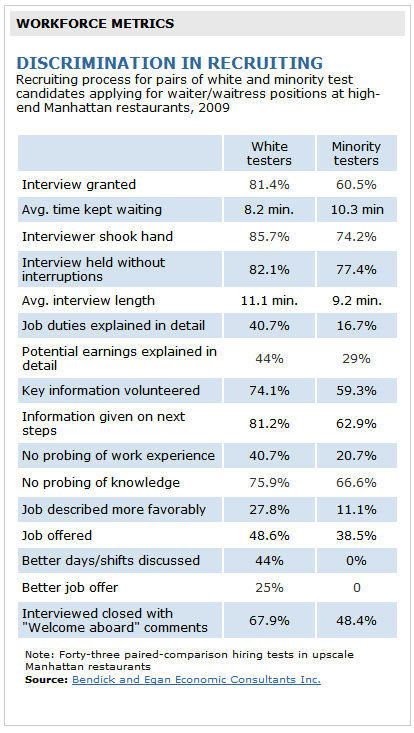
You know you need to do a better job of recruiting diversity candidates, but you're still falling short of your goals. The problem may lie in 'hidden' biases that you're not even aware of. Here's how to combat them.
Don't post the job ad in English only. If your role requires a lot of interaction with a population whose first language isn't English, why not post the job ad (or parts of it) in that language as well as English? You'll attract more diverse candidates - and you may end up with someone who'll be more successful with your customers.
Go easy on jargon and region-specific slang terms in the job ad. Sentences like "Create value by leveraging stakeholder enthusiasm for productivity," are difficult for native English speakers to understand. They're even harder for people whose first language isn't English - and may keep them from applying.
Remove names from resumes before you screen them. Studies show that 'ethnic' names can affect how people perceive resumes. So have an intern remove the names from resumes before you do the screening process. That way you'll know you're judging them on skills, experience and presentation - not on any subconscious preconceptions.
Ensure your recruiting/hiring team is diverse. Diversity candidates tend to perform better when they're screened/interviewed by diversity employees, even if they aren't from the same background.
Make sure every candidate gets the same interview. As the statistics above demonstrate, diverse candidates are often given short shrift in the interview room. By having a formalized interview plan - in which everyone is asked the same questions, provided with the same information, and given the same amount of time, you increase the chances that a diverse candidate will perform well in the interview setting.
Graph above from the workexposed blog
Wednesday, October 12, 2011
Do your employees really know what holidays you're celebrating?
Now that all the stores are featuring huge displays of Hallowe'en candy, I was reminded of an office Hallowe'en party I went to a few years ago, which was a wakeup call about the need for more diversity awareness.
We were all standing around the boardroom eating various pumpkin-shaped Rice Krispie treats, cupcakes with orange and black frosting, and of course there was lots and lots of candy.
One of our newer employees, who'd recently moved to Canada from Mumbai, remarked that she "always" enjoyed these Hallowe'en parties, because she loved candy.
"But," I said, "you weren't here for last Hallowe'en, were you?"
"Well, you know - whatever that last one was where we also had candy."
It took me a second, but then I realized she was referring to an Easter egg hunt we'd had the previous April - which, of course, was also heavy on the sweet treats.
To me, this was a good example of how often we just don't think about diversity in the workplace. It had never occurred to me that to some of our new Canadians, all these celebrations - our office tended to bring out the candy on Valentine's Day, Thanksgiving and even St. Patrick's Day, as well as Hallowe'en and Easter - were a bit bewildering. Sure, most new Canadians, regardless of religion or culture, were aware of Christmas, but 'holidays' like Hallowe'en are often new (and probably meaningless) to them.
More importantly, it made me realize that we weren't doing a good job of celebrating their big days.
Celebrations like the Diwali (Hindu), for example, feature lots of sweetmeats - perfect for an office which likes to bring out the cupcakes and candy for other events!
So this year, when you find yourself putting the company plastic-pumpkin-filled-with-candy in the lobby, you may want to approach one of your new Canadian employees and ask them about their favourite cultural holiday - and then make plans to celebrate it, as well.
We were all standing around the boardroom eating various pumpkin-shaped Rice Krispie treats, cupcakes with orange and black frosting, and of course there was lots and lots of candy.
One of our newer employees, who'd recently moved to Canada from Mumbai, remarked that she "always" enjoyed these Hallowe'en parties, because she loved candy.
"But," I said, "you weren't here for last Hallowe'en, were you?"
"Well, you know - whatever that last one was where we also had candy."
It took me a second, but then I realized she was referring to an Easter egg hunt we'd had the previous April - which, of course, was also heavy on the sweet treats.
To me, this was a good example of how often we just don't think about diversity in the workplace. It had never occurred to me that to some of our new Canadians, all these celebrations - our office tended to bring out the candy on Valentine's Day, Thanksgiving and even St. Patrick's Day, as well as Hallowe'en and Easter - were a bit bewildering. Sure, most new Canadians, regardless of religion or culture, were aware of Christmas, but 'holidays' like Hallowe'en are often new (and probably meaningless) to them.
More importantly, it made me realize that we weren't doing a good job of celebrating their big days.
Celebrations like the Diwali (Hindu), for example, feature lots of sweetmeats - perfect for an office which likes to bring out the cupcakes and candy for other events!
So this year, when you find yourself putting the company plastic-pumpkin-filled-with-candy in the lobby, you may want to approach one of your new Canadian employees and ask them about their favourite cultural holiday - and then make plans to celebrate it, as well.
Tuesday, August 30, 2011
Political Correctness vs Reality
When it comes to actually creating a diverse workforce I have often talked about how it is as simple as making sure that you are looking at everyone. Meanwhile I have written here before about how sometimes that isn't really enough. In the previous context it's because sometimes you need quotas to break the non-diverse culture of an organization.
But I have become more aware of another reason to implement quotas. To actually attract diverse candidates.
Now this isn't applicable to all of our affinity groups, but for some at least the existence of quotas, either formally or informally, actually encourages applicants. To be blunt telling an affinity group that a specific job is going to be filled by someone from their group can, in some cases, make a huge difference in attracting candidates to the role.
On the face of it this flies in the face of my statement that you simply need to look at everyone but I'm not sure that it really does. At the end of the day you can't see all candidates if they are not visible to you and this is really about just making sure that those candidates are visible to you, or in other words making sure that candidates from the different groups are actually applying to your job.
But doesn't encouraging one group to apply in this way actually discourage other groups. Quite possibly yes but again I think that to effect change in the reality of your workforce and hiring cultures you sometimes have to break existing patterns even if it seems somewhat counter-intuitive. I think it helps to take a step back and examine why candidates would be more likely to apply to a job that is being held out for a certain quota.
There is an obvious answer that it seems like less competition. If I as a candidate feel that the number of candidates will be restricted artificially it means a better chance for me to land the job even if I am not the most qualified. This is a point that while cynical has some truth to it but there is a second answer that has more of an impact. For some affinity groups the experience is that even when they are more qualified then other candidates they will be passed over for opportunities. I have talked before about the ways, both passive and active in which this happens but the fact is that either way it does happen. Just because we don't want this experience to be true for diverse candidates doesn't mean that many don't actually have this experience.
In any case though it's a tricky subject to navigate. Do you make it clear that certain roles will only be filled by diverse candidates or do you just rely on your employment brand as a diverse employer to make the difference? We'd all like it to be just the second but again the reality is that for some affinity groups this simply isn't enough.
I don't have an answer to the above questions, although to be honest I don't think that anyone really does. I do think though that if your goal is a truly diverse workplace I'm not sure organizations have any choice but to implement policies, at least in the short-term, like quotas in order to demonstrate to candidates that they are truly committed to a fully inclusive workplace.
But I have become more aware of another reason to implement quotas. To actually attract diverse candidates.
Now this isn't applicable to all of our affinity groups, but for some at least the existence of quotas, either formally or informally, actually encourages applicants. To be blunt telling an affinity group that a specific job is going to be filled by someone from their group can, in some cases, make a huge difference in attracting candidates to the role.
On the face of it this flies in the face of my statement that you simply need to look at everyone but I'm not sure that it really does. At the end of the day you can't see all candidates if they are not visible to you and this is really about just making sure that those candidates are visible to you, or in other words making sure that candidates from the different groups are actually applying to your job.
But doesn't encouraging one group to apply in this way actually discourage other groups. Quite possibly yes but again I think that to effect change in the reality of your workforce and hiring cultures you sometimes have to break existing patterns even if it seems somewhat counter-intuitive. I think it helps to take a step back and examine why candidates would be more likely to apply to a job that is being held out for a certain quota.
There is an obvious answer that it seems like less competition. If I as a candidate feel that the number of candidates will be restricted artificially it means a better chance for me to land the job even if I am not the most qualified. This is a point that while cynical has some truth to it but there is a second answer that has more of an impact. For some affinity groups the experience is that even when they are more qualified then other candidates they will be passed over for opportunities. I have talked before about the ways, both passive and active in which this happens but the fact is that either way it does happen. Just because we don't want this experience to be true for diverse candidates doesn't mean that many don't actually have this experience.
In any case though it's a tricky subject to navigate. Do you make it clear that certain roles will only be filled by diverse candidates or do you just rely on your employment brand as a diverse employer to make the difference? We'd all like it to be just the second but again the reality is that for some affinity groups this simply isn't enough.
I don't have an answer to the above questions, although to be honest I don't think that anyone really does. I do think though that if your goal is a truly diverse workplace I'm not sure organizations have any choice but to implement policies, at least in the short-term, like quotas in order to demonstrate to candidates that they are truly committed to a fully inclusive workplace.
Tuesday, August 9, 2011
Employee Groups : Community Building or Ghettoizing
I had a discussion recently with some HR team members at a large financial institution who have Canadian operations but are mainly in the U.S. and the issues surrounding employee groups for affinity groups came up. If you're not clear what I mean by that many organizations sponsor, support or promote "diversity groups" of their employees. So for example you might have an "African-American" employee group, or an "Aboriginal Employee Support Group" or a "LGBT in the workplace group".
Now again these sorts of groups or employee organizations do exist on both sides of the border although they tend to be more popular south of the border. Why is that? Well for one thing, at least in Canada, there are mixed views on the subject.
The two main schools of thought on this are that either it's a great idea that fosters a sense of community spirit and belonging within a group of employees or it's a terrible idea that creates "ghettos" of employee cliques arranged along lines of ethnicity, skin colour or other groups.
While I can see how, to a certain extent, groups that are by definition exclusive do seem to detract from the goal of inclusion I think that seeing these groups in a very negative light is to miss the point. Employee engagement has become such a "hot" topic, especially in light of the economically uncertain times of late when there is plenty to distract employees, and yet engagement of diverse employees is for many simply an afterthought.
The disconnect that employees can feel from their place of employment is magnified very much for many diverse individuals because, on top of the regular issues, they can feel like "outsiders" at their place of work. In this line anything that an employer can do to make their employees feel more at home in the workplace is going to lead to higher engagement and better productivity.
And at heart that's what these groups are about. Building communities, even smaller ones that may be in some ways exclusionary is an important step in making employees feel at home in an organization.
It's interesting to note that the companies who really "get it", those that engage with all diverse employment groups and not those just covered by legislation, are far more likely to have these groups and tend to do more work to encourage their creation. It speaks I think both to the reality of these groups as a vital part of an effective diversity strategy and the bottom-line fact that diversity inclusion has a positive effect on the success vector of a business.
The idea of embracing diversity in an inclusive way is important, and we should not lose sight of that. But encouraging groups to celebrate their differences with each other isn't harmful to that cause, in fact, in the end it brings us much closer to that goal.
Now again these sorts of groups or employee organizations do exist on both sides of the border although they tend to be more popular south of the border. Why is that? Well for one thing, at least in Canada, there are mixed views on the subject.
The two main schools of thought on this are that either it's a great idea that fosters a sense of community spirit and belonging within a group of employees or it's a terrible idea that creates "ghettos" of employee cliques arranged along lines of ethnicity, skin colour or other groups.
While I can see how, to a certain extent, groups that are by definition exclusive do seem to detract from the goal of inclusion I think that seeing these groups in a very negative light is to miss the point. Employee engagement has become such a "hot" topic, especially in light of the economically uncertain times of late when there is plenty to distract employees, and yet engagement of diverse employees is for many simply an afterthought.
The disconnect that employees can feel from their place of employment is magnified very much for many diverse individuals because, on top of the regular issues, they can feel like "outsiders" at their place of work. In this line anything that an employer can do to make their employees feel more at home in the workplace is going to lead to higher engagement and better productivity.
And at heart that's what these groups are about. Building communities, even smaller ones that may be in some ways exclusionary is an important step in making employees feel at home in an organization.
It's interesting to note that the companies who really "get it", those that engage with all diverse employment groups and not those just covered by legislation, are far more likely to have these groups and tend to do more work to encourage their creation. It speaks I think both to the reality of these groups as a vital part of an effective diversity strategy and the bottom-line fact that diversity inclusion has a positive effect on the success vector of a business.
The idea of embracing diversity in an inclusive way is important, and we should not lose sight of that. But encouraging groups to celebrate their differences with each other isn't harmful to that cause, in fact, in the end it brings us much closer to that goal.
Thursday, August 4, 2011
Why Pride at Work is important to me
Last week an event was held at KPMG in Toronto to launch a new job board for Pride at Work Canada. This new board, powered by the TalentOyster Diversity Network, can be found at http://Careers.PrideAtWork.ca
As part of this event I had the pleasure of speaking for a few minutes and I'd like to share the content of part of my talk here. This isn't the full text because at the end I spoke to the various organizations who attended the event about some technical information on how this new site can interact with their existing career sites. Which if you are a programmer or hiring manager is exciting (maybe) but if you're not is a bit dry so we'll just leave that part out. I think the rest of the story is worth sharing though and here it is.
***
Good evening everyone. My name is Max Stocker and I am the Director of Technology for TalentOyster and I am here tonight to talk to you about the new Pride At Work Canada career site and my dad.
My dad is an immigrant, born in the UK, but raised and educated, including multiple universiy degrees here in Canada. My dad is also transgendered.
For many years she worked, in technology related fields for an enterprise level company. Then she worked as a contractor for several other large organizations but to conclude a long period of soul searching, about 5 years ago she went to Thailand and had a full sex change operation and hasn't had a real job since.
She still does work, on a volunteer basis for her church and for a local LGBT history organization but in terms of meaningful paid employment there is none.
To be honest there are many factors to why this is, but there is no doubt in my mind that the main reason that a highly educated, skilled and experienced person like my dad is not working is because of the way she looks.
At TalentOyster our diversity mandate covers many groups. Aboriginals, visible minorities, new immigrants, persons with disabilities and now, with Pride at Work Canada, LGBT. To us all of these groups, as different as they are all share a too common experience of bias and prejedice based ultimatley on who they are.
Defining terms like diversity or inclusion can be a navel gazing excercise but if I may define inclusion all the same I would say it is an environment in which nobody is being asked to, or forced to, leave part of their identity at home.
We don't ask people who have a different skin colour to leave that at home, or tell persons with disabilities that that's fine but leave it in the privacy of your own home. Things shouldn't be any different for LGBT.
I'd love to see, as Michael Bach was recently quoted as saying, our society move past tolerance in to acceptance but I don't think it will happen over night. What I do think though is that efforts by organizations like Pride at Work, and tonight specifically with this career site we can start to change these attitudes and encourage the formation of working environments, and, even a society that is truly inclusive of everyone. Including my dad.
As part of this event I had the pleasure of speaking for a few minutes and I'd like to share the content of part of my talk here. This isn't the full text because at the end I spoke to the various organizations who attended the event about some technical information on how this new site can interact with their existing career sites. Which if you are a programmer or hiring manager is exciting (maybe) but if you're not is a bit dry so we'll just leave that part out. I think the rest of the story is worth sharing though and here it is.
***
Good evening everyone. My name is Max Stocker and I am the Director of Technology for TalentOyster and I am here tonight to talk to you about the new Pride At Work Canada career site and my dad.
My dad is an immigrant, born in the UK, but raised and educated, including multiple universiy degrees here in Canada. My dad is also transgendered.
For many years she worked, in technology related fields for an enterprise level company. Then she worked as a contractor for several other large organizations but to conclude a long period of soul searching, about 5 years ago she went to Thailand and had a full sex change operation and hasn't had a real job since.
She still does work, on a volunteer basis for her church and for a local LGBT history organization but in terms of meaningful paid employment there is none.
To be honest there are many factors to why this is, but there is no doubt in my mind that the main reason that a highly educated, skilled and experienced person like my dad is not working is because of the way she looks.
At TalentOyster our diversity mandate covers many groups. Aboriginals, visible minorities, new immigrants, persons with disabilities and now, with Pride at Work Canada, LGBT. To us all of these groups, as different as they are all share a too common experience of bias and prejedice based ultimatley on who they are.
Defining terms like diversity or inclusion can be a navel gazing excercise but if I may define inclusion all the same I would say it is an environment in which nobody is being asked to, or forced to, leave part of their identity at home.
We don't ask people who have a different skin colour to leave that at home, or tell persons with disabilities that that's fine but leave it in the privacy of your own home. Things shouldn't be any different for LGBT.
I'd love to see, as Michael Bach was recently quoted as saying, our society move past tolerance in to acceptance but I don't think it will happen over night. What I do think though is that efforts by organizations like Pride at Work, and tonight specifically with this career site we can start to change these attitudes and encourage the formation of working environments, and, even a society that is truly inclusive of everyone. Including my dad.
Thursday, July 14, 2011
We need to be doing so much more
A couple of weeks ago a study was released that revealed some shocking statistics on the potential for new immigrants to Canada and their descendents. In short what the study showed was that in spite of higher than average education levels, income and employment were both below average for second generation Canadians. That is Canadians, born, raised and educated in Canada but who are the sons and daughters of immigrants.
The difficulty of many immigrants in finding meaningful employment is well documented and is usually ascribed to such factors as language issues, difficulty in getting international education credentials recognized or just unfamiliarity with Canadian business culture. The darker and generally unspoken factors are items like ignorance or even outright bigotry and racism. We all want to believe that the latter is not true, that the first reasons, which are all somewhat pragmatic are the reasons immigrants struggle. The results of this study fairly clearly demonstrate that sadly this is not the real case.
We have long believed that building awareness of cultural barriers, the barriers that prevent true inclusiveness is a keystone to a successful diverse workforce strategy. This is in part because the recruiting and sourcing functions of any organization have far more cultural bias inherent in them and far more subjectivity in general then most of us want to ever acknowledge.
I've spoken before on the resume analogy but it remains a good one and so I'll recap it here. If you are a recruiter or screener and there is a position to fill, urgently as of course it almost always is, and you need to pull 10 resumes out of a stack of 100 which resumes and candidates end up being selected? Now we all know that those 100 aren't going to be great, not qualified, lacking experience or just a poorly written resume are all items that can, do and should put us off selecting a candidate. So for example let's say that reduces the list from 100 to 50, how do the final 10 make the cut from those? We can hope that it's for objective reasons but human experience, and the evidence shows that the process is highly subjective and relies foremost on the feeling of connection that you as the screener have for the person whose resume you are holding and cultural affinity, or the perception thereof plays a huge role in that.
The fact that this takes place should really in the end not be surprising, and to some degree at least the screeners and recruiters are not to blame. The process itself is to blame with an emphasis on metrics that do not encourage the treating of all candidates equally and the lack of recognition of the role that subjective analysis plays in the filling of roles. And lest you come away with the impression that it's only the screening process that's broken, it is not, each step in recruitment, candidate selection and hiring has these similar types of flaws, it just happens to be perhaps most blatant at the screening step.
So what can be done about this? I think three things.
Generate awareness. Diversity sensitivity training isn't just a nice thing to do, it really can have practical benefits. While affinity biases won't be eradicated over night sometimes just being aware of an issue, being aware of how an unknown bias is affecting their judgement can help people to re-evaluate some of their decisions in future.
Fix the process. A lot of time and money is spent by companies to metricize and evaluate their hiring and HR processes. It certainly can be said that fully objectifying the hiring process is one of the holy grails of the recruiting and HR worlds. Whether, practically speaking this can actually be accomplished is a matter of some debate but all the same it's worth noting that improvements to the process are going to help diverse candidates, perhaps more than anyone.
Diversify your recruiting, sourcing and HR teams. It almost shouldn't have to be said but one way to eliminate cultural bias towards any group is to include members of that group in the process making the decisions. Fixing the process and raising awareness are both good and noble ideas but can take time to implement and generate results. Making your “front line” hiring and HR functions more diverse will pay immediate dividends in removing these biases and prejudices from you process.
Let's always remember that a moral right or wrong isn't the reason to do any of this. We should feel a moral obligation to do something about the unfairness with a situation like that suggested by the study but that is not the reason to fix it. The reason that you must address the inequality is that until you do you simply aren't hiring all the best candidates. Because until the point that you are sure that you are actually looking at everyone you just won't know what you're missing.
The difficulty of many immigrants in finding meaningful employment is well documented and is usually ascribed to such factors as language issues, difficulty in getting international education credentials recognized or just unfamiliarity with Canadian business culture. The darker and generally unspoken factors are items like ignorance or even outright bigotry and racism. We all want to believe that the latter is not true, that the first reasons, which are all somewhat pragmatic are the reasons immigrants struggle. The results of this study fairly clearly demonstrate that sadly this is not the real case.
We have long believed that building awareness of cultural barriers, the barriers that prevent true inclusiveness is a keystone to a successful diverse workforce strategy. This is in part because the recruiting and sourcing functions of any organization have far more cultural bias inherent in them and far more subjectivity in general then most of us want to ever acknowledge.
I've spoken before on the resume analogy but it remains a good one and so I'll recap it here. If you are a recruiter or screener and there is a position to fill, urgently as of course it almost always is, and you need to pull 10 resumes out of a stack of 100 which resumes and candidates end up being selected? Now we all know that those 100 aren't going to be great, not qualified, lacking experience or just a poorly written resume are all items that can, do and should put us off selecting a candidate. So for example let's say that reduces the list from 100 to 50, how do the final 10 make the cut from those? We can hope that it's for objective reasons but human experience, and the evidence shows that the process is highly subjective and relies foremost on the feeling of connection that you as the screener have for the person whose resume you are holding and cultural affinity, or the perception thereof plays a huge role in that.
The fact that this takes place should really in the end not be surprising, and to some degree at least the screeners and recruiters are not to blame. The process itself is to blame with an emphasis on metrics that do not encourage the treating of all candidates equally and the lack of recognition of the role that subjective analysis plays in the filling of roles. And lest you come away with the impression that it's only the screening process that's broken, it is not, each step in recruitment, candidate selection and hiring has these similar types of flaws, it just happens to be perhaps most blatant at the screening step.
So what can be done about this? I think three things.
Generate awareness. Diversity sensitivity training isn't just a nice thing to do, it really can have practical benefits. While affinity biases won't be eradicated over night sometimes just being aware of an issue, being aware of how an unknown bias is affecting their judgement can help people to re-evaluate some of their decisions in future.
Fix the process. A lot of time and money is spent by companies to metricize and evaluate their hiring and HR processes. It certainly can be said that fully objectifying the hiring process is one of the holy grails of the recruiting and HR worlds. Whether, practically speaking this can actually be accomplished is a matter of some debate but all the same it's worth noting that improvements to the process are going to help diverse candidates, perhaps more than anyone.
Diversify your recruiting, sourcing and HR teams. It almost shouldn't have to be said but one way to eliminate cultural bias towards any group is to include members of that group in the process making the decisions. Fixing the process and raising awareness are both good and noble ideas but can take time to implement and generate results. Making your “front line” hiring and HR functions more diverse will pay immediate dividends in removing these biases and prejudices from you process.
Let's always remember that a moral right or wrong isn't the reason to do any of this. We should feel a moral obligation to do something about the unfairness with a situation like that suggested by the study but that is not the reason to fix it. The reason that you must address the inequality is that until you do you simply aren't hiring all the best candidates. Because until the point that you are sure that you are actually looking at everyone you just won't know what you're missing.
Thursday, July 7, 2011
Stop using the economy as an excuse
It seems that organizations fall into three main groups on the workforce diversity spectrum. Some see the value and are truly committed, a tiny minority just don't care at all and then there's the majority of companies who fall somewhere in between these two categories.
It is hard to know sometimes where individual members of this middle group actually sit even though I engage with many of them on a fairly regular basis in my role as a diversity evangelizer. Almost all of these organizations do have one common attribute, they claim that diversity is important to them. They do see the value. They do care. But...
It's always a but.
One of the reasons I hear right now goes something like "*mumble* recession *mumble* hiring-freeze *mumble* global economic credit issues". On the face of it this seems like a reasonable excuse but here's the reality, Canada is not the U.S! The Canadian economy is not in the same shambles as our neighbours to the south and in fact some areas of Canada continue to experience labour shortages. Second we all know that for enterprise size organizations a "hiring freeze" is only a concept and not a reality. No enterprise level organization goes two years without hiring anybody. Even if hiring for expansion is curtailed, there will still be critical existing roles that will open up and require filling during that time.
More than any of that though is the fact that any excuse is, well, an excuse and it is telling of where your priorities with diversity really are. If your diversity strategy is a plan that is thrown away at the first excuse it's just not much of a strategy at all.
This is the fundamental reason that the organizations that have success with diversity are the ones doing "it" right now. Because the companies who are doing it now are the ones whose strategy is founded on real commitment and that's reflected in their employment brand and the types of candidates available to them. Remember that at the end of the day your employment brand isn't a nice-looking poster or a hilarious viral video but a reflection of the way your organization actually deals with its employees.
Just think about it. If you were a diverse candidate would you want to work for a company that was known for its commitment to diversity? Or the company that had a reputation for being fickle on the issue?
So the next time you find yourself putting off your diversity initiatives because of the economy or any other reason really, ask yourself the questions above. Just know that a diverse candidate is going to answer them in the exact same way that you would.
It is hard to know sometimes where individual members of this middle group actually sit even though I engage with many of them on a fairly regular basis in my role as a diversity evangelizer. Almost all of these organizations do have one common attribute, they claim that diversity is important to them. They do see the value. They do care. But...
It's always a but.
One of the reasons I hear right now goes something like "*mumble* recession *mumble* hiring-freeze *mumble* global economic credit issues". On the face of it this seems like a reasonable excuse but here's the reality, Canada is not the U.S! The Canadian economy is not in the same shambles as our neighbours to the south and in fact some areas of Canada continue to experience labour shortages. Second we all know that for enterprise size organizations a "hiring freeze" is only a concept and not a reality. No enterprise level organization goes two years without hiring anybody. Even if hiring for expansion is curtailed, there will still be critical existing roles that will open up and require filling during that time.
More than any of that though is the fact that any excuse is, well, an excuse and it is telling of where your priorities with diversity really are. If your diversity strategy is a plan that is thrown away at the first excuse it's just not much of a strategy at all.
This is the fundamental reason that the organizations that have success with diversity are the ones doing "it" right now. Because the companies who are doing it now are the ones whose strategy is founded on real commitment and that's reflected in their employment brand and the types of candidates available to them. Remember that at the end of the day your employment brand isn't a nice-looking poster or a hilarious viral video but a reflection of the way your organization actually deals with its employees.
Just think about it. If you were a diverse candidate would you want to work for a company that was known for its commitment to diversity? Or the company that had a reputation for being fickle on the issue?
So the next time you find yourself putting off your diversity initiatives because of the economy or any other reason really, ask yourself the questions above. Just know that a diverse candidate is going to answer them in the exact same way that you would.
Wednesday, June 29, 2011
Diversity and Pride
Back in May an interesting diversity in the workplace story broke and quickly slipped beneath the waves but it's relevant to pride week and so I thought I'd share my thoughts on it now.
The story was about Rick Welts, the CEO of the Phoenix Suns, a professional basketball team playing in the NBA who "came out" as gay in an interview with the New York Times.
It's an interesting story for a couple of reasons, not the least of which is that, as is well known, and as I have personally experienced, team sports at a high competitive or professional level are environments have historically been quite hostile to LGBT persons both individually and collectively. Mr. Welts was quoted in the story saying that "This is one of the last industries where the subject is off limits. Nobody’s comfortable in engaging in a conversation.", and I think that's pretty true. So from simply the aspect of breaking down a barrier it's a pretty significant moment.
But I think there's a more significant aspect to this story then the sports angle and that's the executive angle.
One of the discussions I often have with employers around diversity is on the importance of mentoring programs and there's a good reason for this. You can give your current employees diversity training, you can make sure you are looking at including different groups in your sourcing strategy but if your diverse employees, whatever their affinity group, don't feel that there are roles and a place for them in your company you're simply not getting all that you could be from your diversity strategy.
Now the ideal is of course close mentorships or internships but both of those can require a major investment of time that you simply might not have. That's okay. Even providing example role models for candidates can be helpful. Having diverse individuals at every level of your organization sends a clear message to candidates and employees alike, "there is a place here for you". We're not talking about tokenism here, having two diverse VPs but no diverse people in middle management fools nobody, but when your organizational structure is inclusive all the way through it can inspire and motivate your diverse candidates and employees.
Now having said all that, how does LGBT fit into it? I had an interesting discussion a few months ago with Brent Chamberlain, Executive Director of Pride At Work Canada who made me more aware of how strong some of the stereotypes surrounding LGBT and work can be. For example, there are many young gay men who actually feel that careers as hairdressers, in fashion or as graphic designers are all the opportunities that are open to them. And while any of those careers can be fine it's sad if you think that on the basis of your sexuality you're restricted to them. So in this line one of the programs that Pride at Work talks about is, just like it is for other diversity affinity groups, mentoring. Letting affinity group members know that every opportunity is open to them is an important step.
So back to the story, I think that more than the sports part of it (which I think could be valuable as well), there is the part of being a CEO that I suspect may have more of an impact. The fact Mr. Welts is a CEO of a sports team is no doubt why the story was even covered but the fact he is a CEO may provide inspiration, hope and widening of potential opportunities for young LGBT people no matter what industry they are in.
Or so I would hope.
It's hard to say, or measure, the impact of stories like this on groups as a whole. Is it as impactful as someone working in the same organization as the diverse, or in this case LGBT, candidate? Almost certainly not. But I think it can have some positive impact and that's a start and in this case a good reminder of how far we have come and how far there is in fact to go when we all celebrate the pride events of this week.
The story was about Rick Welts, the CEO of the Phoenix Suns, a professional basketball team playing in the NBA who "came out" as gay in an interview with the New York Times.
It's an interesting story for a couple of reasons, not the least of which is that, as is well known, and as I have personally experienced, team sports at a high competitive or professional level are environments have historically been quite hostile to LGBT persons both individually and collectively. Mr. Welts was quoted in the story saying that "This is one of the last industries where the subject is off limits. Nobody’s comfortable in engaging in a conversation.", and I think that's pretty true. So from simply the aspect of breaking down a barrier it's a pretty significant moment.
But I think there's a more significant aspect to this story then the sports angle and that's the executive angle.
One of the discussions I often have with employers around diversity is on the importance of mentoring programs and there's a good reason for this. You can give your current employees diversity training, you can make sure you are looking at including different groups in your sourcing strategy but if your diverse employees, whatever their affinity group, don't feel that there are roles and a place for them in your company you're simply not getting all that you could be from your diversity strategy.
Now the ideal is of course close mentorships or internships but both of those can require a major investment of time that you simply might not have. That's okay. Even providing example role models for candidates can be helpful. Having diverse individuals at every level of your organization sends a clear message to candidates and employees alike, "there is a place here for you". We're not talking about tokenism here, having two diverse VPs but no diverse people in middle management fools nobody, but when your organizational structure is inclusive all the way through it can inspire and motivate your diverse candidates and employees.
Now having said all that, how does LGBT fit into it? I had an interesting discussion a few months ago with Brent Chamberlain, Executive Director of Pride At Work Canada who made me more aware of how strong some of the stereotypes surrounding LGBT and work can be. For example, there are many young gay men who actually feel that careers as hairdressers, in fashion or as graphic designers are all the opportunities that are open to them. And while any of those careers can be fine it's sad if you think that on the basis of your sexuality you're restricted to them. So in this line one of the programs that Pride at Work talks about is, just like it is for other diversity affinity groups, mentoring. Letting affinity group members know that every opportunity is open to them is an important step.
So back to the story, I think that more than the sports part of it (which I think could be valuable as well), there is the part of being a CEO that I suspect may have more of an impact. The fact Mr. Welts is a CEO of a sports team is no doubt why the story was even covered but the fact he is a CEO may provide inspiration, hope and widening of potential opportunities for young LGBT people no matter what industry they are in.
Or so I would hope.
It's hard to say, or measure, the impact of stories like this on groups as a whole. Is it as impactful as someone working in the same organization as the diverse, or in this case LGBT, candidate? Almost certainly not. But I think it can have some positive impact and that's a start and in this case a good reminder of how far we have come and how far there is in fact to go when we all celebrate the pride events of this week.
Monday, June 27, 2011
Busy of late but a few updates
John and I haven't been doing as much blogging as of late, mainly because this has been a very busy spring (and early summer) for both of us. I know John has a new post he's been working on coming later this week but I thought I would share a few of the updates, features and changes we've been working on the last while since really the TalentOyster from January is already quite different from the TalentOyster of today.
Improved Usability
Over the past few months we've rolled out a number of usability updates for our job-seekers and especially our employers. Better paging of previously posted jobs, a simpler step-by-step wizard for resume searching are just a couple of the improvements we made for our employer users. Based on feedback these features are now easier to navigate and use by normal users than previously.
New Employers
We've added a number of really great, enterprise level employers from across Canada in the last few months including Trillium Health Center, the CBC, Georgian College and most recently Accenture.
TalentOyster Network
Along with the existing EpochJobs.ca (Chinese) white-label site, March saw the launch of our Spanish white label Correo Jobs. We are currently finishing development on two other white labels, one which will launch later this week, and another two are starting development soon. All in all, by the start of the fall we expect the TalentOyster white-label to make up at least 5 different sites and that's not including the sites and organizations who are using OCEAN, the TalentOyster API we launched in March. The TalentOyster Network is already Canada's largest, in real traffic terms, employment focused, network of diverse online diverse properties in Canada and we see continued growth on the horizon.
Improved Usability
Over the past few months we've rolled out a number of usability updates for our job-seekers and especially our employers. Better paging of previously posted jobs, a simpler step-by-step wizard for resume searching are just a couple of the improvements we made for our employer users. Based on feedback these features are now easier to navigate and use by normal users than previously.
New Employers
We've added a number of really great, enterprise level employers from across Canada in the last few months including Trillium Health Center, the CBC, Georgian College and most recently Accenture.
TalentOyster Network
Along with the existing EpochJobs.ca (Chinese) white-label site, March saw the launch of our Spanish white label Correo Jobs. We are currently finishing development on two other white labels, one which will launch later this week, and another two are starting development soon. All in all, by the start of the fall we expect the TalentOyster white-label to make up at least 5 different sites and that's not including the sites and organizations who are using OCEAN, the TalentOyster API we launched in March. The TalentOyster Network is already Canada's largest, in real traffic terms, employment focused, network of diverse online diverse properties in Canada and we see continued growth on the horizon.
Tuesday, June 14, 2011
Addressing a diverse audience – clear communication is key
My colleagues and I often get asked if we have any quick and easy tips for getting more views and higher conversion rates for job posts delivered to a diverse candidate base. To a certain degree there isn't a magic answer that will increase candidate flow just like turning on a tap.
Real success, we know only happens as part of a long term, organic, process. Increasing the SEO visibility of your profile and your opportunities, developing an awareness of your employment brand and getting industry related recognition about your organization (especially in amongst target groups) are all keys to the performance of your posts. Successful sourcing strategies are a bit of a numbers game and the more traffic you have, the more qualified applicants you will also have, regardless of conversion rate.
Having said all that though there are some commonalities to success that improve your posts SEO and improve conversions to posts no matter how many views you are getting. The key here for diverse audiences is, funnily enough, the same as it is for non-diverse audiences. Communicate clearly.
Far too often I see job titles that contain nothing but acronyms and short forms. There is a time and place for SMS style language but the title of a job post isn't one of them. A point made worse when company culture specific acronyms or terminology is used. And these sorts of things don't show up only in the titles of job posts but in the job description detail as well.
For a traditional “mainstream” candidate audience using company specific terms and/or SMS shorthand can be at the least off-putting but imagine how discouraging it can be for diverse groups who are more likely to be able to interpret the language and meaning of such posts.
At the end of the day the job posts are advertisements, just like the B2C or B2B advertisements your organization already uses. The concept of employment branding is real, better candidates will be attracted by a better employment brand. For all the employment branding activity you may do nothing will have as much impact as the “front-line” advertising you do, it’s your first point of contact with the target audience and first impressions are lasting ones. That's why clearly written job posts are so very important.
A job title and description that are well, as in clearly, written are easy to understand and will attract more candidates. They are also a better reflection on your organization as an employment brand and that's the kind of value that will pay off when candidates are more invested in you as a potential employer, giving your opportunities a longer, better look and more likely to share your opportunities with their own network.
Real success, we know only happens as part of a long term, organic, process. Increasing the SEO visibility of your profile and your opportunities, developing an awareness of your employment brand and getting industry related recognition about your organization (especially in amongst target groups) are all keys to the performance of your posts. Successful sourcing strategies are a bit of a numbers game and the more traffic you have, the more qualified applicants you will also have, regardless of conversion rate.
Having said all that though there are some commonalities to success that improve your posts SEO and improve conversions to posts no matter how many views you are getting. The key here for diverse audiences is, funnily enough, the same as it is for non-diverse audiences. Communicate clearly.
Far too often I see job titles that contain nothing but acronyms and short forms. There is a time and place for SMS style language but the title of a job post isn't one of them. A point made worse when company culture specific acronyms or terminology is used. And these sorts of things don't show up only in the titles of job posts but in the job description detail as well.
For a traditional “mainstream” candidate audience using company specific terms and/or SMS shorthand can be at the least off-putting but imagine how discouraging it can be for diverse groups who are more likely to be able to interpret the language and meaning of such posts.
At the end of the day the job posts are advertisements, just like the B2C or B2B advertisements your organization already uses. The concept of employment branding is real, better candidates will be attracted by a better employment brand. For all the employment branding activity you may do nothing will have as much impact as the “front-line” advertising you do, it’s your first point of contact with the target audience and first impressions are lasting ones. That's why clearly written job posts are so very important.
A job title and description that are well, as in clearly, written are easy to understand and will attract more candidates. They are also a better reflection on your organization as an employment brand and that's the kind of value that will pay off when candidates are more invested in you as a potential employer, giving your opportunities a longer, better look and more likely to share your opportunities with their own network.
Tuesday, May 3, 2011
The personal touch and employee engagement
During my conversations with companies across Canada I have noticed that there is a commonality in diversity programs that work and it is a personal touch. It should really come as no big surprise that an effective diversity program goes beyond making a few diversity hires and some niceties in the employee handbook but makes sure there is real, personal engagement with all employees that focuses on that employees specific area of needs.
All companies want high levels of employee engagement, but such engagement is a two way street. Your employees will feel passionate about the success of your business when they feel that your business is equally passionate about them. And there's simply no better way to communicate that to employees than to communicate with them in a personal way.
So that's all nice but what exactly does that mean?
Well the execution specifics can vary but one of the diversity related programs that seems to have the greatest success are internships and mentoring programs.
I think these programs work so well for a number of reasons. For starters the program experience is founded on a one-on-one relationship and that's a good ratio to ensure that the intern or mentee feels that their success is important to the organization as a whole.
Even more though I think that one of the most valuable experiences these programs leave with their participants is being able to see first hand what success looks like. Too often starting in an organization, outside of a sales role, means working in a area where opportunities to move up are limited, or the gap between your work and bottom line success is hard to bridge. These sorts of disconnects can make it difficult for all new employees but the problem is compounded for new employees from diverse backgrounds who may feel even less like they fit in to the success of your company and its future.
When any employee, but especially a diverse one, gets first hand experience of what hard work and real engagement can bring they are far more likely to remain passionate about the organization.
And again none of this should really be rocket science but if you find yourself wondering why your diversity initiative isn't working remember it's time tested programs like mentoring that really do make the difference. Having good intentions is all well and good but having a personal touch with new employee engagement is what stands out most about companies who are successful with diversity.
All companies want high levels of employee engagement, but such engagement is a two way street. Your employees will feel passionate about the success of your business when they feel that your business is equally passionate about them. And there's simply no better way to communicate that to employees than to communicate with them in a personal way.
So that's all nice but what exactly does that mean?
Well the execution specifics can vary but one of the diversity related programs that seems to have the greatest success are internships and mentoring programs.
I think these programs work so well for a number of reasons. For starters the program experience is founded on a one-on-one relationship and that's a good ratio to ensure that the intern or mentee feels that their success is important to the organization as a whole.
Even more though I think that one of the most valuable experiences these programs leave with their participants is being able to see first hand what success looks like. Too often starting in an organization, outside of a sales role, means working in a area where opportunities to move up are limited, or the gap between your work and bottom line success is hard to bridge. These sorts of disconnects can make it difficult for all new employees but the problem is compounded for new employees from diverse backgrounds who may feel even less like they fit in to the success of your company and its future.
When any employee, but especially a diverse one, gets first hand experience of what hard work and real engagement can bring they are far more likely to remain passionate about the organization.
And again none of this should really be rocket science but if you find yourself wondering why your diversity initiative isn't working remember it's time tested programs like mentoring that really do make the difference. Having good intentions is all well and good but having a personal touch with new employee engagement is what stands out most about companies who are successful with diversity.
Friday, April 29, 2011
LinkedIn : The future of recruiting?
There isn't much doubt that LinkedIn represents a very new and powerful way of using the web for sourcing and recruiting talent. It's the first popularly successful example of connecting social networking to business for recruiting purposes and certainly it represents a sea change in how organizations view and invest in their recruiting function.
But exactly how big of a change is it?
I have heard it suggested that LinkedIn is a death knell for the job board industry. That would of course be a significant change (as well as bad news for me) but is it true?
I don't think so.
Let's first remember that employment advertising and branding, just like all advertising and branding is designed to influence decision making at purchase time. That's a process that starts well in advance of the purchase and effective advertising seeks to get messaging about product top of mind with the purchaser so that at the correct time they are more likely to consider and/or buy your specific product.
When it comes to employment advertising the goals are the same. Yes, of course posted opportunities will get applicants who are currently looking for work and just happen to see your job and apply, but there is also a process of enticing passive candidates and top talent for your business that goes beyond the number of applicants for a position.
Top talent, when looking for work is going to start by identifying the companies and positions that they want to work for. The criteria by which specific organizations will depend on the individual but in the case of diversity specifically may include questions such as the inclusiveness of the organization, opportunities for career advancement and ... You want your organization to be included in this short list of potential employers and the only way to do that is through employment branding and advertising.
Job boards allow you extensive and non-replaceable opportunities for employment advertising in several ways including the amount of exposure available. This isn't just traffic we are talking about here but very targeted traffic of people who are either actively looking for employment or at least considering a new role. The brand message on a job board and subsequent SEO are undiluted by your B2C or B2B brand messages which is key to making sure your employment brand is being seen by the target audience at a time that they are open and receptive to it.
But can't I do the same thing on LinkedIn? Surely their audience is my target and receptive to my employment branding?
Yes but like any advertising you can't just throw up an ad in one place and call it a day. You don't limit your B2C advertising to TV or print or online or billboards, instead you choose as many options as you can so that your message is seen by the largest number of your target audience as possible. In the same way that I will tell you that because TalentOyster as a diversity niche job board (with a niche audience) means that you should be using mainstream sourcing boards (like Monster) as well as and not instead of TalentOyster the same applies for job boards vs. social networking recruiting tools like LinkedIn.
If tomorrow you took all your jobs off Monster and posted them all on LinkedIn instead would you see an impact?
There would be a short-term impact, although the exact drop-off in applications would vary based on your industry and overall brand but the more significant impact would be in the longer term (6 months or more). As time went on I believe you would experience a serious drop in applicants fro top talent coupled with a lack of interest in your positions from passive candidates. Being absent from job boards means you would no longer be top of mind for candidates when it comes to planning where they want to work.
There's also the matter of who exactly is on LinkedIn. Is it a "mainstream" social network representing the non-diverse audience? It certainly seems that way. As we already know making sure that your message is being seen by everyone requires a sourcing strategy that looks beyond the mainstream.
Don't get me wrong, LinkedIn is an excellent tool for your recruiting and sourcing "toolbox". But at the end of the day it is a tool, not a one-stop solution for all of your online recruiting needs.
But exactly how big of a change is it?
I have heard it suggested that LinkedIn is a death knell for the job board industry. That would of course be a significant change (as well as bad news for me) but is it true?
I don't think so.
Let's first remember that employment advertising and branding, just like all advertising and branding is designed to influence decision making at purchase time. That's a process that starts well in advance of the purchase and effective advertising seeks to get messaging about product top of mind with the purchaser so that at the correct time they are more likely to consider and/or buy your specific product.
When it comes to employment advertising the goals are the same. Yes, of course posted opportunities will get applicants who are currently looking for work and just happen to see your job and apply, but there is also a process of enticing passive candidates and top talent for your business that goes beyond the number of applicants for a position.
Top talent, when looking for work is going to start by identifying the companies and positions that they want to work for. The criteria by which specific organizations will depend on the individual but in the case of diversity specifically may include questions such as the inclusiveness of the organization, opportunities for career advancement and ... You want your organization to be included in this short list of potential employers and the only way to do that is through employment branding and advertising.
Job boards allow you extensive and non-replaceable opportunities for employment advertising in several ways including the amount of exposure available. This isn't just traffic we are talking about here but very targeted traffic of people who are either actively looking for employment or at least considering a new role. The brand message on a job board and subsequent SEO are undiluted by your B2C or B2B brand messages which is key to making sure your employment brand is being seen by the target audience at a time that they are open and receptive to it.
But can't I do the same thing on LinkedIn? Surely their audience is my target and receptive to my employment branding?
Yes but like any advertising you can't just throw up an ad in one place and call it a day. You don't limit your B2C advertising to TV or print or online or billboards, instead you choose as many options as you can so that your message is seen by the largest number of your target audience as possible. In the same way that I will tell you that because TalentOyster as a diversity niche job board (with a niche audience) means that you should be using mainstream sourcing boards (like Monster) as well as and not instead of TalentOyster the same applies for job boards vs. social networking recruiting tools like LinkedIn.
If tomorrow you took all your jobs off Monster and posted them all on LinkedIn instead would you see an impact?
There would be a short-term impact, although the exact drop-off in applications would vary based on your industry and overall brand but the more significant impact would be in the longer term (6 months or more). As time went on I believe you would experience a serious drop in applicants fro top talent coupled with a lack of interest in your positions from passive candidates. Being absent from job boards means you would no longer be top of mind for candidates when it comes to planning where they want to work.
There's also the matter of who exactly is on LinkedIn. Is it a "mainstream" social network representing the non-diverse audience? It certainly seems that way. As we already know making sure that your message is being seen by everyone requires a sourcing strategy that looks beyond the mainstream.
Don't get me wrong, LinkedIn is an excellent tool for your recruiting and sourcing "toolbox". But at the end of the day it is a tool, not a one-stop solution for all of your online recruiting needs.
Thursday, April 21, 2011
What does diversity mean to you?
Seems like a simple question doesn't it? But I think the answer can tell a lot about where an organization is on the diversity scale.
It starts with the "big four" groups inherited from the legal/equity perspective, visible minorities, aboriginal, women and persons with disabilities but in most cases diversity in a company means more than that. Other groups that are often part of it may include new immigrants, LGBT and older workers. But there are even more than that.
I recently came across a definition of diversity that included occupation types! The general idea is that when we talk about “uniting in diversity” we need to be including all the different groups that make up our organization, including groups that are not obvious at first glance. And when you think about it, the concept of inclusion does mean that different business function areas in your company should be working together just as different ages, races or genders are inside each one.
So is diversity really just another word for teamwork?
Someone once said that diversity isn't about the differences between us but about the uniqueness we all share. Isn't that also a good definition of good teamwork?
Successful teamwork takes the unique skills and strengths of individual members and uses them to achieve shared objectives that wouldn't otherwise be reachable on their own. I think you can say the same for successful diversity workforce initiatives. As an organization we source from a number of alternate sources, tapping unique skills and experience in order to best achieve the goal of hiring the best possible candidate.
I have said it before and I'll say it again, diversity isn't about accommodation or promoting the inferior, it's about the best talent you can find. The only way you can have the best talent is if you can find and hire it, and you can't do that unless you are looking at everyone. So I guess you might say that for me, diversity, in the employment sense is as simple as this, "look at everyone". I'm not sure it needs to be any more complicated really.
It starts with the "big four" groups inherited from the legal/equity perspective, visible minorities, aboriginal, women and persons with disabilities but in most cases diversity in a company means more than that. Other groups that are often part of it may include new immigrants, LGBT and older workers. But there are even more than that.
I recently came across a definition of diversity that included occupation types! The general idea is that when we talk about “uniting in diversity” we need to be including all the different groups that make up our organization, including groups that are not obvious at first glance. And when you think about it, the concept of inclusion does mean that different business function areas in your company should be working together just as different ages, races or genders are inside each one.
So is diversity really just another word for teamwork?
Someone once said that diversity isn't about the differences between us but about the uniqueness we all share. Isn't that also a good definition of good teamwork?
Successful teamwork takes the unique skills and strengths of individual members and uses them to achieve shared objectives that wouldn't otherwise be reachable on their own. I think you can say the same for successful diversity workforce initiatives. As an organization we source from a number of alternate sources, tapping unique skills and experience in order to best achieve the goal of hiring the best possible candidate.
I have said it before and I'll say it again, diversity isn't about accommodation or promoting the inferior, it's about the best talent you can find. The only way you can have the best talent is if you can find and hire it, and you can't do that unless you are looking at everyone. So I guess you might say that for me, diversity, in the employment sense is as simple as this, "look at everyone". I'm not sure it needs to be any more complicated really.
Thursday, April 7, 2011
The Chicken and the Egg
Last week I was doing some catch up reading on some back issues of HR Reporter when an article caught my eye and almost immediately it caused me to ask myself a question that I have been pondering since. The article was on the link between a good business culture and real business success. It reported that companies who were perceived, by outsiders to have the best culture were the most successful in Canada.
My question though was which of those come first? The article was at the very least trying to imply that culture comes first, that creating a positive, business culture is one of the things that leads to success. I think there is something to that but in reality I'm not sure that you can breed a positive culture without having success first.
We'd all like to think that while the culture of a business could be separated from the level of success, or lack thereof, that a business has, the reality is it cannot. When times are good employees are going to reflect this and so will the general business atmosphere and culture meanwhile when times are bad the inverse is equally true. Everybody would prefer to work for a “winner” and nobody wants to work in an environment where they are worried about the future, the viability of the company and their job security.
At the same time though it's important to recognize that cultures are not fixed forever. If your business is going through a downturn you are not “doomed” to a downward spiral of negative environment producing poor results. Every business will have its ups and downs and businesses do adapt and change all the time.
Now applying this to the diversity space, how does a company become diverse? Do you start by adding diverse candidates or do you need to incorporate diversity into your business culture first?
No real question here that you need diverse candidates, without making hires that reflect your commitment to diversity your plans are hollow but... if your business culture doesn't embrace diversity will top diverse talents stay with your organization?
Which all leads to the question of how you are supposed to incorporate diversity into a culture if you don't have any (or much) diversity yet. As my colleague John wrote earlier in the week organizations that are successful with diversity know that both a top-down and bottom-up strategy is needed and I think the same applies here. If you want a diverse culture you need to bring in diverse candidates of course, but you can't overlook making sure your culture reflects the diversity of where you really want to go.
My question though was which of those come first? The article was at the very least trying to imply that culture comes first, that creating a positive, business culture is one of the things that leads to success. I think there is something to that but in reality I'm not sure that you can breed a positive culture without having success first.
We'd all like to think that while the culture of a business could be separated from the level of success, or lack thereof, that a business has, the reality is it cannot. When times are good employees are going to reflect this and so will the general business atmosphere and culture meanwhile when times are bad the inverse is equally true. Everybody would prefer to work for a “winner” and nobody wants to work in an environment where they are worried about the future, the viability of the company and their job security.
At the same time though it's important to recognize that cultures are not fixed forever. If your business is going through a downturn you are not “doomed” to a downward spiral of negative environment producing poor results. Every business will have its ups and downs and businesses do adapt and change all the time.
Now applying this to the diversity space, how does a company become diverse? Do you start by adding diverse candidates or do you need to incorporate diversity into your business culture first?
No real question here that you need diverse candidates, without making hires that reflect your commitment to diversity your plans are hollow but... if your business culture doesn't embrace diversity will top diverse talents stay with your organization?
Which all leads to the question of how you are supposed to incorporate diversity into a culture if you don't have any (or much) diversity yet. As my colleague John wrote earlier in the week organizations that are successful with diversity know that both a top-down and bottom-up strategy is needed and I think the same applies here. If you want a diverse culture you need to bring in diverse candidates of course, but you can't overlook making sure your culture reflects the diversity of where you really want to go.
Monday, April 4, 2011
Bottom up or top down?
Last week I was interested to read about a bit of a commotion in Germany regarding women in the workplace. It seems that women only make up 3.2% of the members of executive or advisory boards of Germany's top 200 companies. That's a bad number, what makes it even worse, and what the stories last week were about, is that it's a problem that German business has been trying to address for ten years.
Back in 2001 German companies introduced voluntary targets to raise the representation of women in executive or advisory roles. Chancellor Angela Merkel described the effect of these voluntary targets as "modest results" and said that more needs to be done. But really, if 3.2% represents "improvement" when a demographic number would suggest more in the range of 50% the situation really is quite bad.
An outcome of this is that the German Minister of Labour has threatened to impose mandatory quotas that businesses would have to achieve. The numbers being talked about are 30% by 2018, which would be a significant change. As expected, the threat to impose mandatory quotas is not without controversy of course, with companies who would be affected complaining about the possible interference in running strong businesses. In the end the government stated that businesses have 2 more years (till 2013) to triple the number of women in executive roles or the government would force business to address the issue.
It will be interesting to see how this plays out, tripling the number in three years sounds very aggressive until you consider that's still only about 9.5%. It's also interesting to note the excuses and reasons given by these companies. As per usual they claim the results of their strategy simply aren't paying off yet, that they are integrating women into their corporate culture and promotion structure but it takes time to see the results of this at the very top.
No question, bottom up strategies have the largest potential benefit for all those involved. Companies get employees who are invested in the process and are well acclimated with the culture, needs and strategies of the business. But does it actually work?
Historically the conclusion would have to be no. Implementing diversity strategies with only a bottom-up approach seems to time and again to fail and there are good reasons for this.
In the German example we can see one of the reasons why, it takes so long to see results that it's difficult to know if it's working... or not. Now common sense would say that with only 3% it almost certainly is not working, but the businesses make the case that it's impossibly to tell yet and apparently in this case the government agrees that that might be true. True or not the point of difficulty in measuring success in intermediate terms is a problem here and when the success of a strategy is measured in decade cycles that's a real issue.
A second problem, but one I believe just as bad if not worse is that bottom-up strategies don't shock the culture into the change that is needed in order to make the strategy a success. When diverse employees (women or otherwise) look up the corporate ladder and only see white males in the top roles what sort of message do you think that sends to them? How motivational do you think that is? What kind of trust in your diversity strategy will employees who see this have?
Right about as much as you think. And the problem of leadership not reflecting your diversity goals extends to more than just if diverse employees believe you, it's also about the vision and direction of your organization as a whole. Executives in leadership roles are, well, leaders. A company can't really have an inclusive vision without inclusivity in its visionaries.
Don't get me wrong, as I said earlier bottom-up strategies do have long term benefits for companies, investing in top talent will in the long haul bring results. But a bottom-up strategy when it comes to making a company more diverse just doesn't work, on it's own. It's not a question of bottom-up or top-down, but recognizing that to have an effective strategy when it comes to diversity, you need a little bit of both.
Back in 2001 German companies introduced voluntary targets to raise the representation of women in executive or advisory roles. Chancellor Angela Merkel described the effect of these voluntary targets as "modest results" and said that more needs to be done. But really, if 3.2% represents "improvement" when a demographic number would suggest more in the range of 50% the situation really is quite bad.
An outcome of this is that the German Minister of Labour has threatened to impose mandatory quotas that businesses would have to achieve. The numbers being talked about are 30% by 2018, which would be a significant change. As expected, the threat to impose mandatory quotas is not without controversy of course, with companies who would be affected complaining about the possible interference in running strong businesses. In the end the government stated that businesses have 2 more years (till 2013) to triple the number of women in executive roles or the government would force business to address the issue.
It will be interesting to see how this plays out, tripling the number in three years sounds very aggressive until you consider that's still only about 9.5%. It's also interesting to note the excuses and reasons given by these companies. As per usual they claim the results of their strategy simply aren't paying off yet, that they are integrating women into their corporate culture and promotion structure but it takes time to see the results of this at the very top.
No question, bottom up strategies have the largest potential benefit for all those involved. Companies get employees who are invested in the process and are well acclimated with the culture, needs and strategies of the business. But does it actually work?
Historically the conclusion would have to be no. Implementing diversity strategies with only a bottom-up approach seems to time and again to fail and there are good reasons for this.
In the German example we can see one of the reasons why, it takes so long to see results that it's difficult to know if it's working... or not. Now common sense would say that with only 3% it almost certainly is not working, but the businesses make the case that it's impossibly to tell yet and apparently in this case the government agrees that that might be true. True or not the point of difficulty in measuring success in intermediate terms is a problem here and when the success of a strategy is measured in decade cycles that's a real issue.
A second problem, but one I believe just as bad if not worse is that bottom-up strategies don't shock the culture into the change that is needed in order to make the strategy a success. When diverse employees (women or otherwise) look up the corporate ladder and only see white males in the top roles what sort of message do you think that sends to them? How motivational do you think that is? What kind of trust in your diversity strategy will employees who see this have?
Right about as much as you think. And the problem of leadership not reflecting your diversity goals extends to more than just if diverse employees believe you, it's also about the vision and direction of your organization as a whole. Executives in leadership roles are, well, leaders. A company can't really have an inclusive vision without inclusivity in its visionaries.
Don't get me wrong, as I said earlier bottom-up strategies do have long term benefits for companies, investing in top talent will in the long haul bring results. But a bottom-up strategy when it comes to making a company more diverse just doesn't work, on it's own. It's not a question of bottom-up or top-down, but recognizing that to have an effective strategy when it comes to diversity, you need a little bit of both.
Monday, March 28, 2011
LGBT - The forgotten diversity group
In some ways it seems like an odd thing to say that LGBT is the "forgotten" diversity group because, at least in Canada, alternative genders and lifestyles have become largely an accepted community (or at the very least a well known one) and yet I think when it comes to issues of employment there is an element of truth to it.
There are a couple of reasons for this, the first being that it's an example of the gap that can exist between "awareness" and "action" when it comes to any business culture changing initiatives, but of course specifically as we are most interested in, diversity ones. In short knowing that we should be doing something or aren't doing enough is better than not knowing, but it isn't the same as actually doing something.
Part of the issue here is that sometimes knowing that we should be doing something doesn't mean that we actually know what that something is. As a diversity group LGBT can fall into this category because for many organizations both knowing how to identify members of this group and what steps to take to make sure that they are incorporated as part of a diversity strategy are a bit tricky.
Like any successful corporate strategy it begins with clearly communicating objectives to all employees. Making sure that employees know what sorts of behaviour are acceptable and not acceptable when it comes to LGBT groups should be done just like any other diversity group. Even more fostering a culture of acceptance and inclusion starts with everyone understanding what the expectations are, and what the eventual goals are and those should be communicated clearly as well. When all the members of the team know what the goal is, that is having success by creating a diverse culture that is welcoming to the best candidates for all opportunities, you're more likely to reach that goal.
LGBT can also be difficult to address from the diversity standpoint because members of this group are more likely to be victims of quiet discrimination. The reality of the "old boys club" lives on and can exclude LGBT just like women, visible minorities and others. Sometimes members of diverse groups aren't being actively discriminated against but their opportunities for advancement in an organization are limited because they don't participate in the same social events or share the same interests that members of management might.
The second reason I think that LGBT can get overlooked has to do with cultural sensitivities and it's possibly even more of a problem. The fact is that there are many cultures and countries where LGBT personas are not seen as acceptable and/or wanted. Even in North America there are groups who would seek to persecute and discriminate against others on the basis of their sexual orientation and when it comes to opinions the world over this, sadly, counts as enlightened. It's a serious problem and its tentacles do extend into diversity initiatives here as well.
For example, with some cultural groups who historically and currently in their home countries suppress and/or discriminate against LGBT how can your organization be inclusive of both these groups? It almost seems impossible on the face of it, the existence of one group is offensive to another group so how can the two co-exist?
The fact of the matter is that while it does seem like a complication it is no different than the challenge of inclusion with any other diverse groups who might historically not get along. Ask yourself this question: how would you include both Arabs and Jews into your organization? What about Hindus and Muslims? You wouldn't think twice about encouraging groups to express themselves but at the same time setting clear boundaries on what sorts of behaviours are appropriate. The same standards should apply to LGBT.
It's not always about inclusion, it's often simply about making sure we're not allowing groups to be excluded and anyone who can be victimized on the basis of their race, religion, gender, background or sexual orientation deserves the same level of protection against exclusion.
There are a couple of reasons for this, the first being that it's an example of the gap that can exist between "awareness" and "action" when it comes to any business culture changing initiatives, but of course specifically as we are most interested in, diversity ones. In short knowing that we should be doing something or aren't doing enough is better than not knowing, but it isn't the same as actually doing something.
Part of the issue here is that sometimes knowing that we should be doing something doesn't mean that we actually know what that something is. As a diversity group LGBT can fall into this category because for many organizations both knowing how to identify members of this group and what steps to take to make sure that they are incorporated as part of a diversity strategy are a bit tricky.
Like any successful corporate strategy it begins with clearly communicating objectives to all employees. Making sure that employees know what sorts of behaviour are acceptable and not acceptable when it comes to LGBT groups should be done just like any other diversity group. Even more fostering a culture of acceptance and inclusion starts with everyone understanding what the expectations are, and what the eventual goals are and those should be communicated clearly as well. When all the members of the team know what the goal is, that is having success by creating a diverse culture that is welcoming to the best candidates for all opportunities, you're more likely to reach that goal.
LGBT can also be difficult to address from the diversity standpoint because members of this group are more likely to be victims of quiet discrimination. The reality of the "old boys club" lives on and can exclude LGBT just like women, visible minorities and others. Sometimes members of diverse groups aren't being actively discriminated against but their opportunities for advancement in an organization are limited because they don't participate in the same social events or share the same interests that members of management might.
The second reason I think that LGBT can get overlooked has to do with cultural sensitivities and it's possibly even more of a problem. The fact is that there are many cultures and countries where LGBT personas are not seen as acceptable and/or wanted. Even in North America there are groups who would seek to persecute and discriminate against others on the basis of their sexual orientation and when it comes to opinions the world over this, sadly, counts as enlightened. It's a serious problem and its tentacles do extend into diversity initiatives here as well.
For example, with some cultural groups who historically and currently in their home countries suppress and/or discriminate against LGBT how can your organization be inclusive of both these groups? It almost seems impossible on the face of it, the existence of one group is offensive to another group so how can the two co-exist?
The fact of the matter is that while it does seem like a complication it is no different than the challenge of inclusion with any other diverse groups who might historically not get along. Ask yourself this question: how would you include both Arabs and Jews into your organization? What about Hindus and Muslims? You wouldn't think twice about encouraging groups to express themselves but at the same time setting clear boundaries on what sorts of behaviours are appropriate. The same standards should apply to LGBT.
It's not always about inclusion, it's often simply about making sure we're not allowing groups to be excluded and anyone who can be victimized on the basis of their race, religion, gender, background or sexual orientation deserves the same level of protection against exclusion.
Friday, March 11, 2011
The TalentOyster Network : a combined approach to diversity talent sourcing
Even though (or perhaps because of) we work in the field, we can tell you that driving diverse candidate traffic is not an easy thing. The short answer as to why is the amount of market fragmentation that exists. There are many, many, many diverse communities and markets in Canada but most of them are, relatively speaking, quite small. It's only in combining them that a candidate flow strategy can really make sense which is one of the reasons we call it Canada's Hidden Talent Pool.
The creation of TalentOyster was based on the principle of funnelling candidates from these fragmented markets into one collective pool from the perspective of companies looking to hire. TalentOyster is different because it is the only diversity related employment portal that was built around a traffic strategy first and the only one deeply connected to the existing multi-cultural media community in Canada.
In this line, right from the start TalentOyster has been connected to diverse cultural communities across Canada through the media partner network of our parent publishing company. This has given us a great start when it comes to candidate flow but as we have learned a strategy more proactive than advertisements and editorial content in newsmedia publications is required. We initially moved on this strategy by being leading edge in leveraging social media with programs like our Tweeting of Jobs and pushing updates to candidates via email, RSS and SMS. But we realized that these aren't always enough either so enter the TalentOyster Network.
The TalentOyster Network is a network of white-label sites built on the TalentOyster platform and sites using the TalentOyster API.
Our White-Label sites leverage the trust candidates have in an existing community/media brand by wrapping a custom branded job-board solution built on TalentOyster and featuring the opportunity and employment content of our site for some of the affinity groups and communities we work with. Without all the buzzwords what does that mean? Well check out EpochJobs.ca, a Chinese language website, managed by a community trusted newsmedia publisher (EpochTimes) that features TalentOyster content. It's just one example of how we are expanding the funnel concept through our white-label network and we're adding more trusted partners in more affinity groups all the time, including Hispanic, South Asian, Aboriginal and LGBT.
The second and even newer way we are being more proactive in increasing our candidate flow is via OCEAN, a REST API for TalentOyster. OCEAN lets anyone interested to embed job search functionality and content from TalentOyster right into their own website. Sites can execute searches for job on TalentOyster, get results and then format and display them, however they like, to their own visitors. In some ways you can think of it is as a White-Label "lite".
Either way we're excited about our new funnel concept. We think by remaining the only diversity job board with a candidate traffic first vision we will continue to improve upon what is already the best streams of diversity candidate flow in the country. Because the more great candidates are connected to great employers the more everyone gains.
The creation of TalentOyster was based on the principle of funnelling candidates from these fragmented markets into one collective pool from the perspective of companies looking to hire. TalentOyster is different because it is the only diversity related employment portal that was built around a traffic strategy first and the only one deeply connected to the existing multi-cultural media community in Canada.
In this line, right from the start TalentOyster has been connected to diverse cultural communities across Canada through the media partner network of our parent publishing company. This has given us a great start when it comes to candidate flow but as we have learned a strategy more proactive than advertisements and editorial content in newsmedia publications is required. We initially moved on this strategy by being leading edge in leveraging social media with programs like our Tweeting of Jobs and pushing updates to candidates via email, RSS and SMS. But we realized that these aren't always enough either so enter the TalentOyster Network.
The TalentOyster Network is a network of white-label sites built on the TalentOyster platform and sites using the TalentOyster API.
Our White-Label sites leverage the trust candidates have in an existing community/media brand by wrapping a custom branded job-board solution built on TalentOyster and featuring the opportunity and employment content of our site for some of the affinity groups and communities we work with. Without all the buzzwords what does that mean? Well check out EpochJobs.ca, a Chinese language website, managed by a community trusted newsmedia publisher (EpochTimes) that features TalentOyster content. It's just one example of how we are expanding the funnel concept through our white-label network and we're adding more trusted partners in more affinity groups all the time, including Hispanic, South Asian, Aboriginal and LGBT.
The second and even newer way we are being more proactive in increasing our candidate flow is via OCEAN, a REST API for TalentOyster. OCEAN lets anyone interested to embed job search functionality and content from TalentOyster right into their own website. Sites can execute searches for job on TalentOyster, get results and then format and display them, however they like, to their own visitors. In some ways you can think of it is as a White-Label "lite".
Either way we're excited about our new funnel concept. We think by remaining the only diversity job board with a candidate traffic first vision we will continue to improve upon what is already the best streams of diversity candidate flow in the country. Because the more great candidates are connected to great employers the more everyone gains.
Subscribe to:
Posts (Atom)